Sustainable student companies in the Bergisches Land region
The project is technically and financially supported by the German Federal Environmental Foundation (DBU)
Project duration: 06/2018 - 05/2021
Project volume: €124,654
Project partners
Prof. Dr Christine Volkmann: Jackstadt Centre for Entrepreneurship and Innovation Research; Chair of Entrepreneurship, Innovation and Transformation & UNESCO Chair of Entrepreneurship and Intercultural Management
Norbert Peikert: KURS21 e.V.
Dominik Kitzinger: Association of Cooperatives - Association of Regions e.V.
Starting point
The establishment of student companies has been very popular for some time now. The objectives associated with student-run companies are diverse and range from better preparing students for training and careers to teaching specific qualifications and trialling new teaching concepts. They provide a valuable opportunity to develop initiative, independence, entrepreneurial knowledge and skills.
Sustainable student companies, and this is the primary focus of the project, not only want to be economically successful. They also want to pursue ecological and social goals. The product, production and operation should be designed in such a way that nature is burdened as little as possible, the pupils are personally strengthened in their social skills, can practise working together and also experience social problems such as joint economic activity in the One World. Networked thinking in the sustainability triangle of economy, environment and social issues should be learnt.
Core objective
The project sees itself as an active and effective contribution to the global transformation towards a climate-friendly society. This includes achieving a concrete change in behaviour among individual stakeholders and consumers - specifically among young people and teachers in their involvement at school, but also in their role as private consumers. The young people in the student companies are given real and sustainable incentives to act with a direct impact on economic activity at school and beyond. The students themselves take responsibility and, as active agents, determine the objectives of the sustainable student companies with decisions and actions and implement them. In this way, they become both a vehicle and a model for the motivation and commitment of all those involved in the school. The figures of economic activity are self-efficacious indicators of success. In addition, the student companies adopt self-developed or selected controlling procedures and discuss their actions in a spirit of solidarity (self-evaluation). Furthermore, the student co-operatives in particular have agreed on binding supporting and safeguarding structures (e.g. articles of association with business objectives, general meeting, supervisory board, annual audit).
Instruments
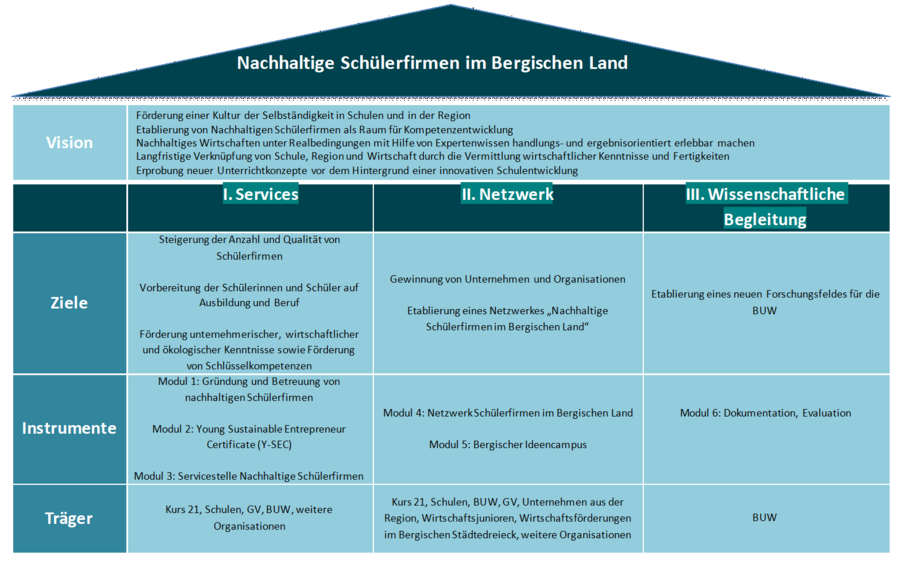
The "Sustainable Student Companies in the Bergisches Land" project bundles its activities in the following, harmonised toolbox:
1. development and introduction of a "Young Sustainable Entrepreneur Certificate (YSEC)" and testing of models for recognising the YSEC at universities and companies
2. development of future-proof innovative business ideas and models for sustainable student companies
3. development of standards for quality assurance and professionalisation of student company work with the support of small and medium-sized local companies
4. reviewing and incorporating existing materials and structures that make the topic of "sustainability" more organisable for the target group
5. sustainable inclusion and consolidation of existing student company concepts (e.g. NaSch community, student cooperatives and startgreen@school)
6. impetus for the transition from a sustainable school company to the professional phase of life
Synopsis
The entire project can be visualised as follows